
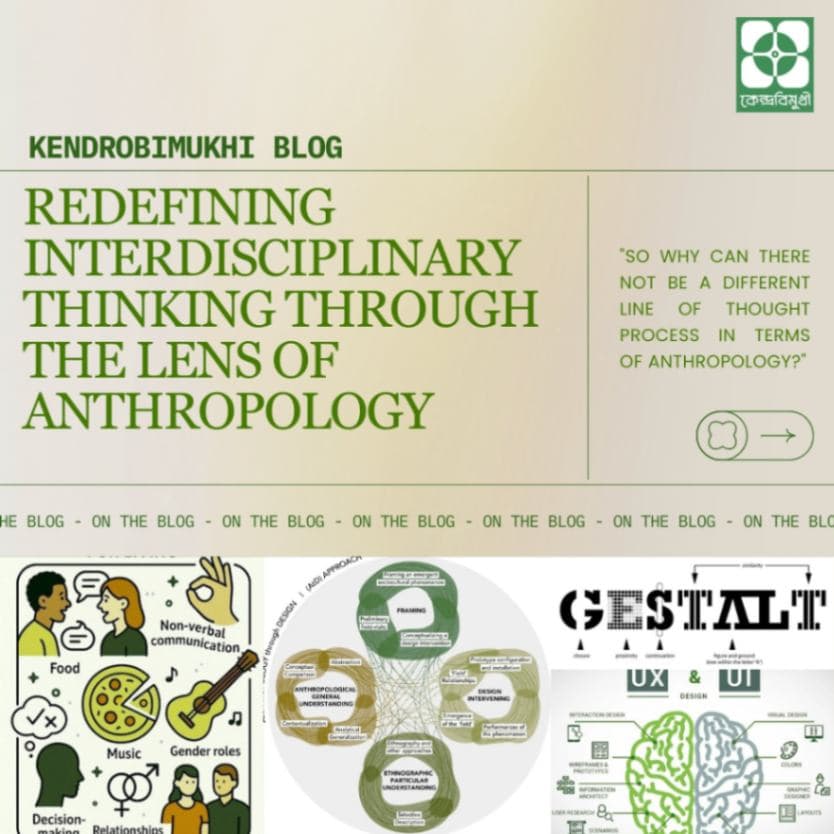
A Fresh Perspective on Interdisciplinary Thinking Through the Lens of Anthropology
Redifining Interdiscilinary thinking through the lens of anthropology
Arnab Fouzder
BRAC University
What if Anthropology isn’t “the easy way out” but the missing piece? We live in a country where CSE promises security, BBA promises corporate power, and social sciences are constantly asked: “But what will you do with this degree?” If you’ve ever questioned your major, switched departments, struggled between financial independence and intellectual curiosity, or felt boxed in by how disciplines are traditionally taught, this one’s for you.
As someone who was always confused about the payoffs of higher education when it came to the job market of Bangladesh, especially when considering the almost six-year commitment to STEM-based education to get a proper job, it was clear to me from early on that I did not have this luxury due to my socio-economic background. I started to pursue BBA during admissions, only to realise that I can’t really sell the most cliche “pen,” let alone anything complex. I got selected to study International Relations at Dhaka University, then realised that studying social sciences in that “thing” people call a University (completely subjective opinion) is not for me, because I couldn’t do well even in Bangladesh and Global Studies in school. It was a very immature decision, but one that I do not regret. In the end, I came to the half-hearted realisation that studying CSE might be the way to go, because otherwise, why are so many people studying it? And once I started, it occurred to me that people, whether incapable, pretentious or intelligent - everyone came here, at least in private universities, for the name of the degree or because their parents told them to. While my intentions were a combination of both, I still questioned the end goal. And that did not look well for me. “Financial freedom” of some sort was important from an early age for me. As I tried avoiding tuition, I often ended up finding graphic design or video editing gigs, where I was self-aware that I lacked quality. And with CSE labs and every other thing taking up my time, I was not able to keep up. I was not in a position or had the luxury to compromise study for work, and it led me to constantly fight for one choice over another as I was being torn apart into wanting to choose any one. Things changed, however, as I started a job in a marketing/branding agency as a Junior Designer. I was learning from a mentor and was also getting paid an okay-ish amount. Then I realised that I must focus on one thing, rather than being all over the place. Leveraging one particular field of study in relation to another made me think that User Experience Design can be a way in which I can incorporate CSE and design. However, the faculties were against it. So I looked for a supposedly easy way out. The goal was simple. Get good grades, but utilise the degree or major in a way that can act as a backup, in case designing fails. I tried going into Media and Cultural Studies. It had potential. But going through the aged faculties was tough. The department did not have a good track record of ambitious students trying to achieve what they wanted by not following the given formula. And leaving CSE after studying for 2 years made matters worse in terms of gaining the professors’ trust. I still moved forward, hoping for the best, until I was advised to pursue Anthropology by a faculty member, Turzo Nicholas Mondol Sir. Changing my department for the third or perhaps fourth time was a feat in itself, but I somehow managed to get into Anthropology - a major I never knew existed. I began again with the intention of not turning back. That first semester was rough. Getting a “C” in a course titled “Anthropology of Development” almost made me feel that I had made a mistake. However, there was another professor, Dr. Moiyen Zalal Chowdhury, who later became my supervisor and who was deeply interested in digital media. With his guidance, I finally found a way to connect design and anthropology. At first, that connection existed only within academics. My workplace also played a major role because it helped me understand that designs can fail when people find a brand difficult to relate to and judge it based on their economic realities. The more I learned, the more connections I began to see. With greater clarity, I decided to complete my degree at a faster pace. It was very difficult to convince some of the older professors how computational linguistics works and why anthropology and human behaviour matter in design. When design either shapes or interprets psychological patterns, it becomes an area worth exploring. Eventually, Dr. Moiyen Zalal decided to take a chance on supervising me. Anthropology at BRAC University, and in most universities in the country, usually expects graduates to complete a thesis. I could have followed that path, but I believed practical data was essential to prove my point. I became the first student to pursue an anthropological internship instead of a conventional thesis so that I could demonstrate a tangible connection between these disciplines. I can say with confidence that the results exceeded expectations. Under no circumstances am I belittling the way anthropology is taught at my university or by its faculty members. In fact, I was genuinely surprised when I presented my final work, which I consider my magnum opus, and the faculty finally understood my perspective. It was as if the faculties FINALLY spoke my language, making me think why this knowledge, which they clearly possess in greater depth, was not being taught. I did not and still do not concern myself with whether other students fully understand it (but in hindsight, I should). Many who choose to study anthropology seem to view it as an easier path to completing their undergraduate degree. Some female students are drawn toward feminism and gender studies, while many of the male students, who are fewer in number, lean toward development studies. Recently, areas related to politics and digital spaces have also been explored by students. A significant portion of these areas is approached without much depth. Regardless, many eventually enter NGOs or realize that financial growth in this field is limited unless they pursue a master’s degree and move into academia or development organizations. A few students step outside this pattern because they have the soft skills that help them understand marketing for different generations or content strategy in today’s digital landscape. The issue is that people are still stuck in the past and are not interested in understanding that anthropology can go beyond your average NGO, gender, children, and domestic workers. Bangladesh has enough work on these. My goal was to prove anthropology can be more. For example, CSE students in design and development are not looking into culture. They're not doing methodological research before designing a digital product for the people. Business students in marketing are still bubbled with their SWOTS and everything they've learnt, barely touching the surface of how culture and marketing can intertwine. They think they know enough, but they don’t. That’s the problem. The interdisciplinary approach is missing. I admit my words are harsh. After majoring in Anthropology, minoring in CSE, specializing in UX/UI design, and working in a branding agency for over three years, obviously I see perspectives others don’t. A CSE graduate with an MBA understands the industry and business side of things far more than someone with their undergrad and masters solely in business. That is a proven fact. So why can't there be a different line of thought process with Anthropology? I am tired of listening to 21 to 25 year olds talk about capitalism, politics and other trendy topics thinking they know them to a greater extent. Do they really know more than the surface level? If they're put in a situation where they need to earn money without coming from money, most wouldn’t last. Real perspective comes from struggle, from connecting disciplines, from noticing overlooked details. Woke culture throws around words such as inclusivity and accessibility without understanding the technology and people behind it. A designer from a marketing background will be more focused on selling a product, another one from a CSE background will be more focused on solving a technical problem, while the designer with an Anthropology background will be more focused on every other issue that is not addressed above, with proper research. We're content by design, yet unaware of our gaps in knowledge. I believe it is about time people look into the outcomes of Anthropology differently. While gender and development studies is important, this generation should have the influence from faculties and graduates to explore the areas where the integration Anthropology still lacks. The discipline must expand, and I believe to have done a good job of planting a seed for it in my university, which I hope to see growing now, or over time.